Many businesses treat leads and customers the same way.
This creates confusion.
Leads need nurturing. Customers need support and relationship management.
Both require different processes.
That is where lead management and customer management become important.
What Is Lead Management?
Lead management is the process of tracking and managing potential customers before they make a purchase.
A lead is someone who showed interest in your business.
Examples:
- Filled out a website form
- Sent a WhatsApp message
- Called your business
- Downloaded a brochure
- Asked for pricing
Lead management helps you move these prospects toward conversion.
Lead management includes:
- Capturing enquiries
- Assigning leads to sales staff
- Tracking follow-ups
- Scheduling calls and meetings
- Managing sales stages
- Monitoring conversions
The goal is simple.
Convert leads into paying customers.
What Is Customer Management?
Customer management starts after the sale.
Once someone becomes a customer, your focus changes.
Now you manage the relationship.
Customer management helps businesses improve retention, communication, and long-term satisfaction.
Customer management includes:
- Managing customer records
- Tracking purchase history
- Handling support requests
- Scheduling renewals
- Sending updates and reminders
- Building long-term relationships
The goal is retention and repeat business.
The Main Difference
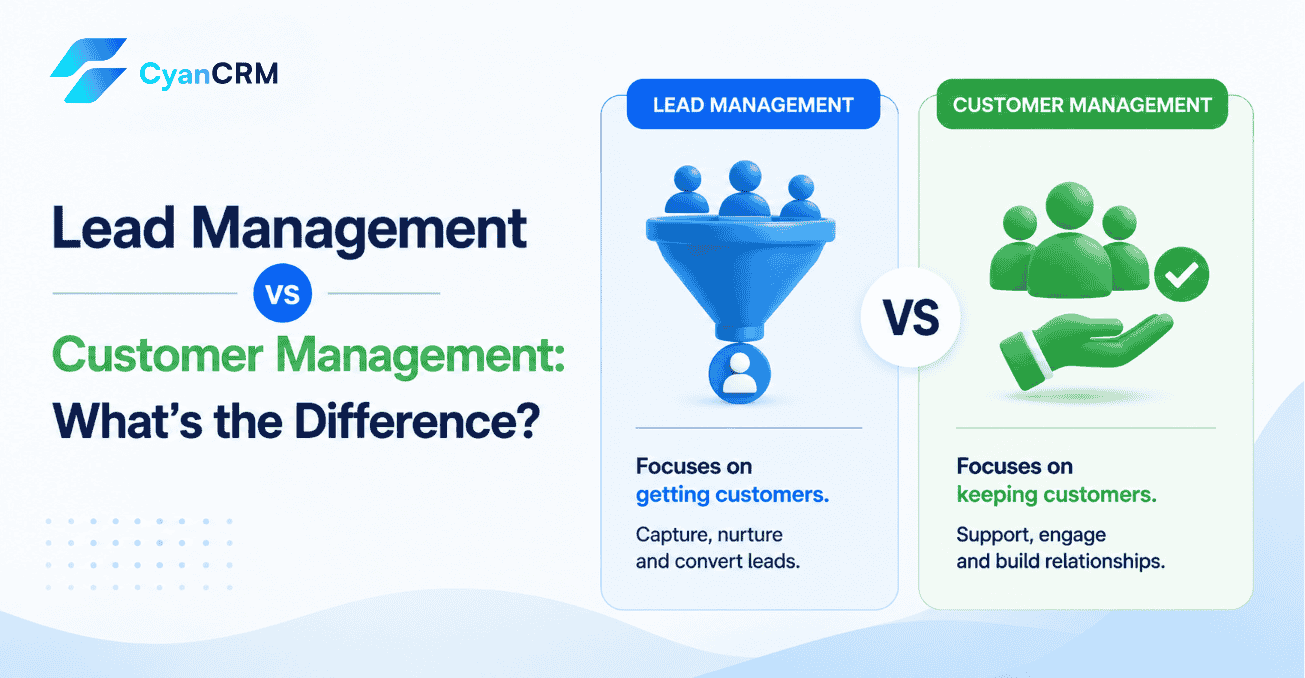
Lead management focuses on getting customers.
Customer management focuses on keeping customers.
Here is a simple breakdown:
| Lead Management | Customer Management |
|---|---|
| Handles prospects | Handles existing customers |
| Focuses on sales conversion | Focuses on retention |
| Tracks enquiries and follow-ups | Tracks customer interactions |
| Used before purchase | Used after purchase |
| Managed mainly by sales teams | Managed by support and account teams |
Both are important.
But they solve different business problems.
Example of Lead Management
A student submits an enquiry for IELTS coaching.
Your CRM:
- Captures the enquiry
- Assigns it to a counsellor
- Sends follow-up reminders
- Tracks counselling status
- Schedules demo sessions
The student is still a lead.
Once the student pays and enrolls, the process changes.
Now customer management begins.
Example of Customer Management
After enrollment, your team manages:
- Batch updates
- Fee reminders
- Student progress
- Support requests
- Feedback collection
The focus shifts from conversion to experience.
Why Businesses Need Both
Many businesses focus only on generating leads.
But growth depends on both acquisition and retention.
Without lead management:
- Leads get missed
- Follow-ups become inconsistent
- Conversion rates drop
Without customer management:
- Customers lose interest
- Retention falls
- Referrals decrease
A proper CRM handles both.
How CRM Software Connects Both Processes
Modern CRM software combines lead and customer management in one system.
This creates continuity.
Your team sees the full customer journey from first enquiry to long-term relationship.
For example:
- Sales teams manage leads
- Support teams manage customers
- Managers track performance
- Data stays centralized
This improves visibility across departments.
Benefits of Lead Management
Good lead management helps businesses:
- Respond faster
- Improve follow-up consistency
- Increase conversions
- Track sales performance
- Reduce lead leakage
According to InsideSales, responding to leads within 5 minutes increases conversion chances significantly compared to delayed responses.
Speed matters.
Benefits of Customer Management
Strong customer management helps businesses:
- Improve customer satisfaction
- Increase repeat business
- Build loyalty
- Generate referrals
- Reduce churn
Retaining customers costs less than acquiring new ones.
According to Harvard Business Review, increasing customer retention by 5% increases profits by 25% to 95%.
Retention impacts revenue directly.
Signs Your Business Has Weak Lead Management
You likely have lead management problems if:
- Leads stay in spreadsheets
- Follow-ups get missed
- Teams respond slowly
- Sales tracking lacks clarity
- Managers lack visibility
These problems reduce conversions.
Signs Your Business Has Weak Customer Management
Customer management problems often look like this:
- Customers repeat the same information
- Support responses are delayed
- Renewals get missed
- Communication feels inconsistent
- Customer records stay scattered
This hurts retention.
Which One Should You Prioritize?
You need both.
But your starting point depends on your business stage.
If your business struggles with enquiries and conversions, improve lead management first.
If your business already has steady customers, focus on customer management and retention.
Most growing businesses eventually need both systems working together.
How CyanCRM Supports Both Lead and Customer Management
Businesses need one system to manage both new leads and existing customers. CyanCRM helps teams capture leads, automate follow-ups, track sales activity, and maintain customer relationships from a single platform. This improves visibility and keeps teams organized at every stage.
Final Thoughts
Lead management and customer management serve different purposes.
One helps you win customers.
The other helps you keep them.
Businesses that manage both effectively create smoother operations, better customer experiences, and stronger long-term growth.
A CRM helps connect these processes in one organized system.